

Nine modules, two form factors and reconfigurable hardware for Modbus, PROFINET and EtherNet/IP. SENECA expands its remote I/O range to simplify integration, spare parts management and plant upgrades.
A machine supplied to different customers may need different communication architectures: PROFINET for one production line, EtherNet/IP for another, or Modbus to integrate with an existing plant. For machine builders, this variability often means managing more part numbers and keeping more components in stock.
By extending FLEX technology to EtherNet/IP, SENECA addresses these requirements with the same I/O hardware, which can be reconfigured to suit the required protocol.
What FLEX Changes
SENECA’s proprietary FLEX technology allows users to change the communication protocol of compatible modules via software, switching between Modbus, PROFINET and EtherNet/IP without replacing the device.
Terminal blocks, field wiring and I/O point mapping remain unchanged. The practical benefit is a common hardware platform that can be used on machines with different control architectures, reducing bill of materials variants.
Reconfiguration is performed using the free SENECA Discovery Device utility. Once the PC is connected via Ethernet, users identify the module and select the required communication configuration. The procedure also involves adjusting the DIP switches to reset the device and reload the configuration.
The PLC and network configuration must still be adapted to the selected protocol: FLEX simplifies the reuse of I/O hardware and field connections.
Nine Modules for Digital Signals, Analog Signals and Weighing
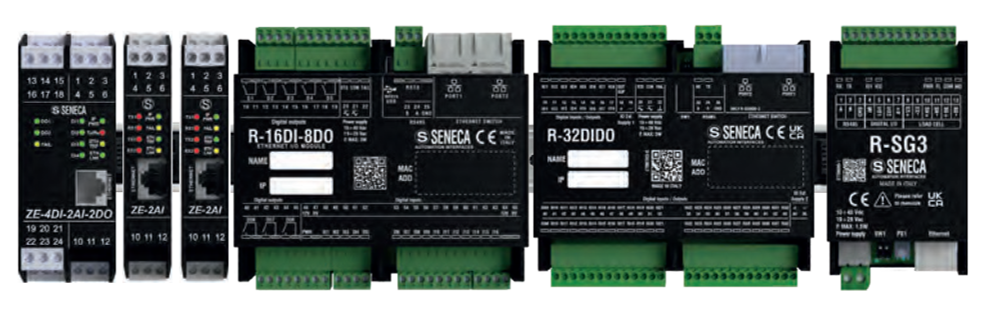
The EtherNet/IP range includes six R Series modules and three ZE Series modules, featuring a 100 Mbps Ethernet interface.
The R Series, with a depth of 32 mm, provides solutions for a variety of acquisition and control requirements:
- R-32DIDO-E: 32 configurable digital channels.
- R-8AI-8DIDO-E: 8 analog inputs with 24-bit resolution and 8 digital channels.
- R-4RTD-8DIDO-E: 4 RTD inputs and 8 digital channels.
- R-4AO-8DIDO-E: 4 analog current or voltage outputs and 8 digital channels.
- R-2AI-6DIDO-E: a compact solution with 2 analog inputs and 6 digital channels.
- R-SG3-E: load cell acquisition with built-in tare, stable weight detection, predictive filtering and piece counting functions.
The ZE Series, in a 17.5 mm-wide Z-PC form factor, is designed for applications requiring a small number of I/O points and a compact DIN rail footprint. It includes the ZE-2AI-E for analog signals, the ZE-SG3-E for load cells, and a mixed version with analog and digital inputs.
Daisy Chain Wiring and Communication Continuity
R Series modules feature two 10/100 Mbps Ethernet ports, allowing devices to be connected sequentially in a daisy chain topology. This arrangement can reduce the need for external switches and simplify wiring.
The fault-bypass function maintains Ethernet traffic to downstream devices if a module fails or loses power. The affected node remains unavailable, but communication can continue along the chain.
Where Flexibility Delivers Value
For OEMs serving export markets, FLEX enables I/O hardware standardization while allowing the configuration to match the control system required by each customer.
In retrofit projects, compatible modules can be reconfigured when the plant’s communication protocol changes, preserving the connections to sensors and actuators.
Spare parts management also becomes simpler: a single hardware part number can support multiple communication configurations, reducing the number of variants that need to be purchased and kept in stock.
With EtherNet/IP and FLEX, SENECA expands the ways remote I/O can be used throughout a machine’s lifecycle, from initial installation to subsequent upgrades.