

In recent years, industrial automation has undergone a profound transformation. Digitization, IIoT, remote assistance, energy management, cybersecurity and cloud integration have progressively enriched the systems with new features. However, this evolution has also brought with it a side effect: increasing architectural complexity. Many modern plants combine dedicated gateways, separate PLCs, industrial routers, data loggers, edge computers, and heterogeneous cloud platforms. Historically, every new technological need has been addressed by adding a new device. The result is an infrastructure that is increasingly powerful but also more difficult to manage, integrate and protect.
In this context, Adaptive Automation was born, a paradigm developed by SENECA, an Italian company active for almost forty years in the design of components and systems for industrial automation. The idea behind it is simple: not to increase the complexity of the system by introducing new devices, but to reduce it by integrating multiple functions into a single evolutionary platform. The guiding principle can be summarized as follows: when the requirement changes, the device is not replaced, the configuration is changed. Automation therefore becomes a flexible platform capable of adapting over time to the evolution of production systems.
The Adaptive Industrial Node
In the Adaptive Automation paradigm, the industrial device is no longer a static component but an intelligent node of the network. Functions traditionally distributed between different devices converge in a single platform: IEC 61131-3 programmable control, multiprotocol conversion, data logging, integrated web server, IIoT connectivity and secure remote assistance services.
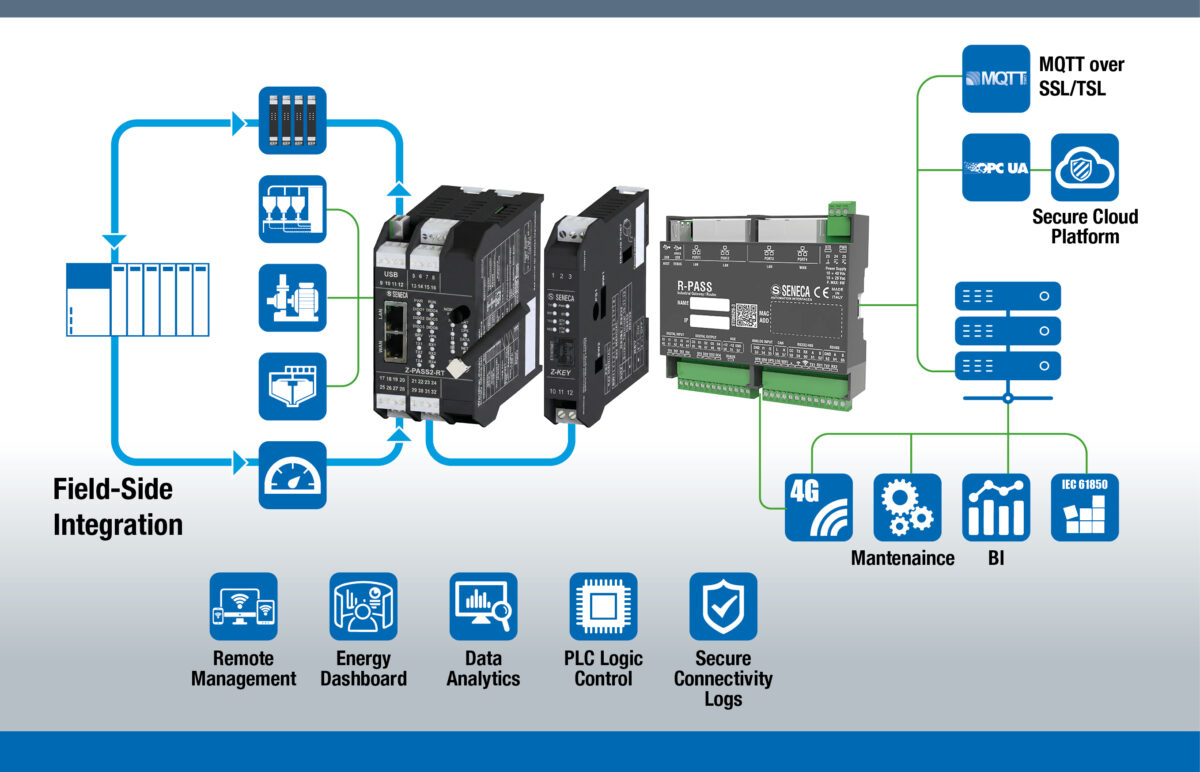
IIoT architecture with SENECA Edge adaptive nodes that concentrates PLC functionality, Energy Controller, IIoT Gateway, 4G Router, remote alarm unit, remote assistance, datalogger
The intelligence is placed close-to-the-field, close to the machine or the electrical panel. This approach reduces latency, improves operational resilience, and allows the plant to continue operating even if connectivity to external systems is lost.
Adaptive Automation is also a human-centric model: technology must simplify operator operations, not multiply configuration points. The evolution of the system takes place mainly through software updates and reconfigurations, avoiding invasive hardware replacements.
The four pillars of architecture
The Adaptive Automation paradigm is based on four integrated technology elements: FLEX, Unified Firmware, Distributed Security, and Easy Cloud.
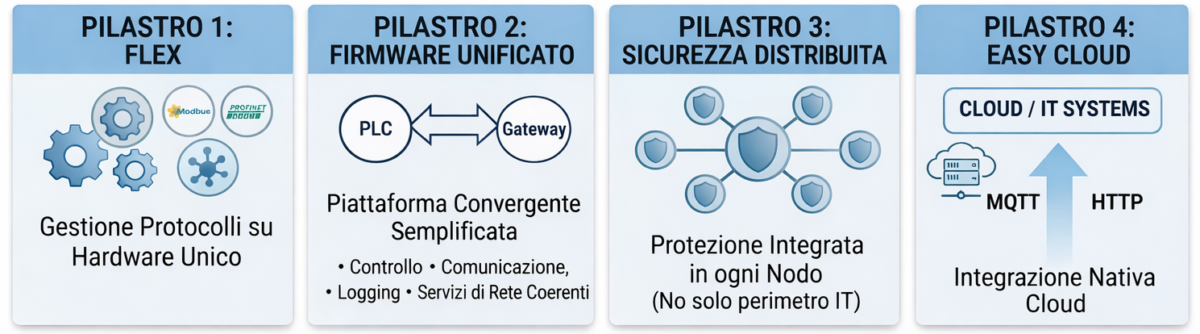
The pillars of Adaptive Automation
FLEX – adaptive industrial communication
FLEX enables dynamic management of industrial protocols on a single multiprotocol hardware. The same device can operate with different standards such as Modbus, Profinet IO, Ethernet/IP, OPC UA, IEC 61850 or MQTT simply by changing the software configuration. This approach makes it easier to retrofit systems and reduces the number of hardware variants that need to be managed.
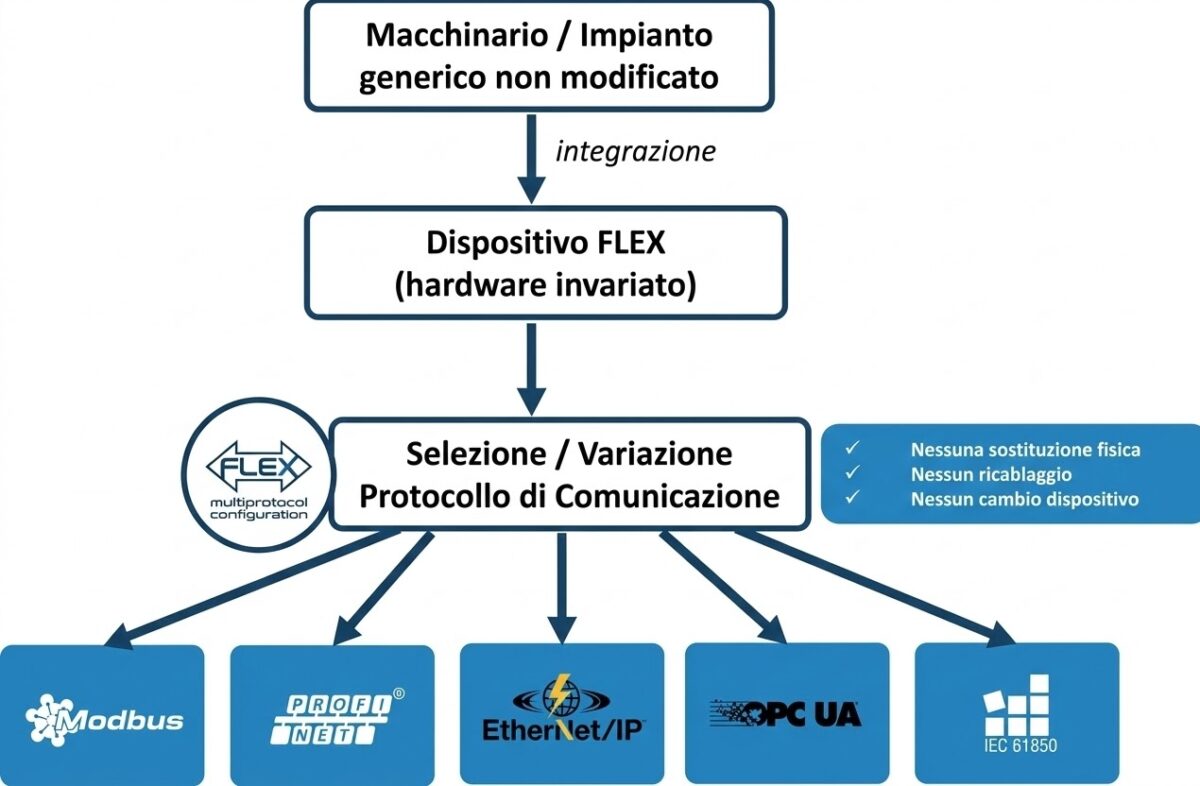
FLEX: Selection of the communication protocol without hardware modifications, rewiring, or device replacements.
Unified Firmware – Converged Software Platform
The firmware integrates PLC, gateway, datalogging and cloud connectivity functions into a single platform. In SENECA devices, data from industrial buses, Ethernet networks or I/O inputs flow into a common shared memory on which PLC logics, multiprotocol services and IIoT functions operate simultaneously. Control, acquisition and processing therefore work on the same operational data.
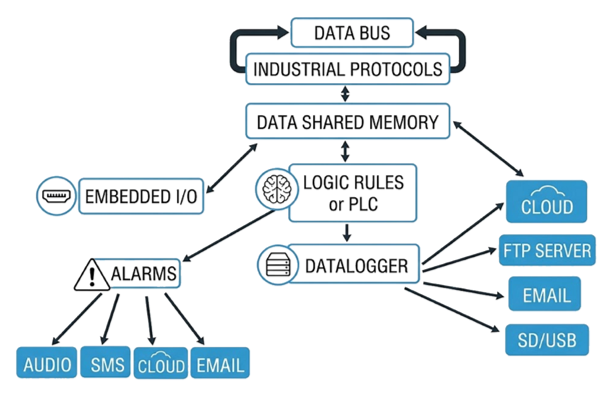
Unified firmware architecture: Communication, logic, datalogging, and alarm management integrated into a single platform.
Distributed security
Cybersecurity is conceived as an intrinsic property of the device and not as a simple perimeter protection. Edge nodes integrate strong authentication, HTTPS/TLS encryption, digital certificates, signed firmware, and access control. The approach is consistent with IEC 62443 standards and the European regulatory framework NIS2 and Cyber Resilience Act.
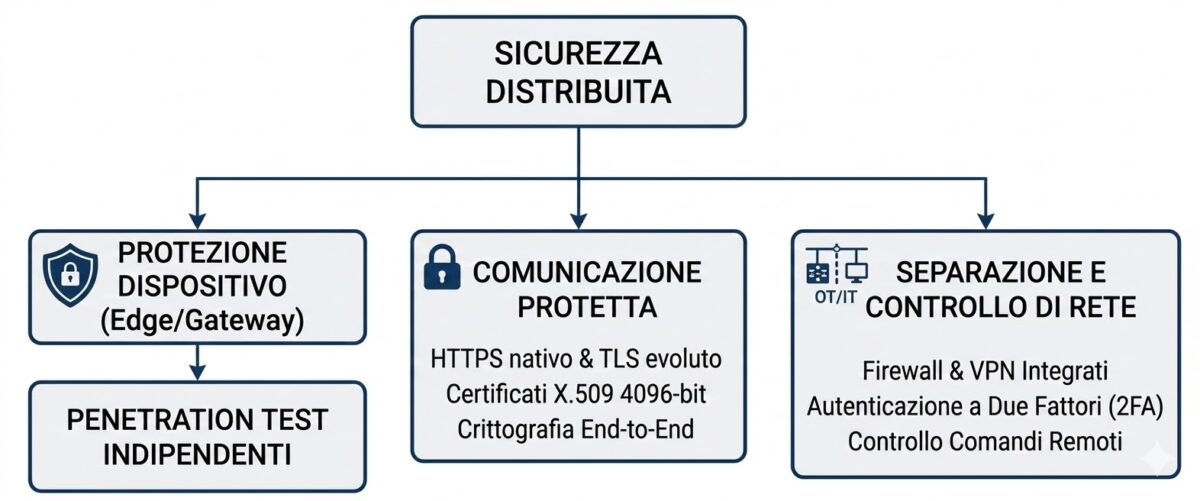
Distributed security: device protection, encrypted communications, and secure control of the OT/IT network.
Easy Cloud – direct integration with digital services
Easy Cloud simplifies the connection between the industrial edge and cloud platforms through pre-configured MQTT and HTTP templates. Devices can directly publish data to higher systems without intermediate gateways or complex middleware. Some of the processing takes place directly at the edge node, reducing data traffic and latency.
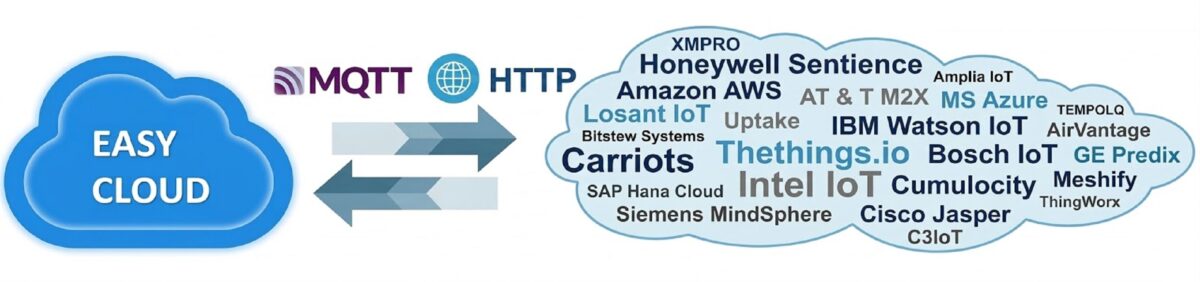
Easy Cloud: Easy integration with IoT platforms via standard protocols such as MQTT and HTTP.
Operational benefits
The adoption of Adaptive Automation produces concrete benefits on a technical and managerial level. Reducing architectural complexity is the first result: fewer devices mean fewer configurations, less wiring, fewer points of failure, less energy consumed.
A second advantage concerns the extension of the life cycle of the plants. Because the role of devices is primarily determined by software, infrastructure can evolve over time without massive hardware replacements.
The model also promotes greater operational resilience. The plant can adapt to new protocols, changes in supervisory systems, or new IIoT needs without interrupting operation.
Adaptive Automation therefore represents a conceptual evolution of industrial automation. In the traditional model, the infrastructure is static: when the requirement changes, the device is replaced. In the adaptive paradigm, on the other hand, the plant becomes an evolutionary platform in which functions can be redefined through software configuration.
Innovation is not just about introducing new technologies, but about coordinating control, communication, security, and cloud in a unified, configurable architecture.
In this perspective, automation no longer imposes constraints on the industrial process: it becomes itself capable of adapting to the process.